TearDown
MISSION 001
India's next leap into space
VIKRAM–1
On 18 July 2026, it lifted off from Sriharikota and became India's first private rocket to reach orbit — carrying four small satellites to about 450 km up.
Why should I care?
- 01A company did this, not a space agency. Two ex-ISRO engineers, eight years, one shot.
- 02One rocket = many brutally hard systems that all have to work, in the right order, once.
- 03Its last-stage engine is 3D printed in one piece — and can restart itself in space.
Named after Dr. Vikram Sarabhai, the physicist who started India's space programme in
1962.
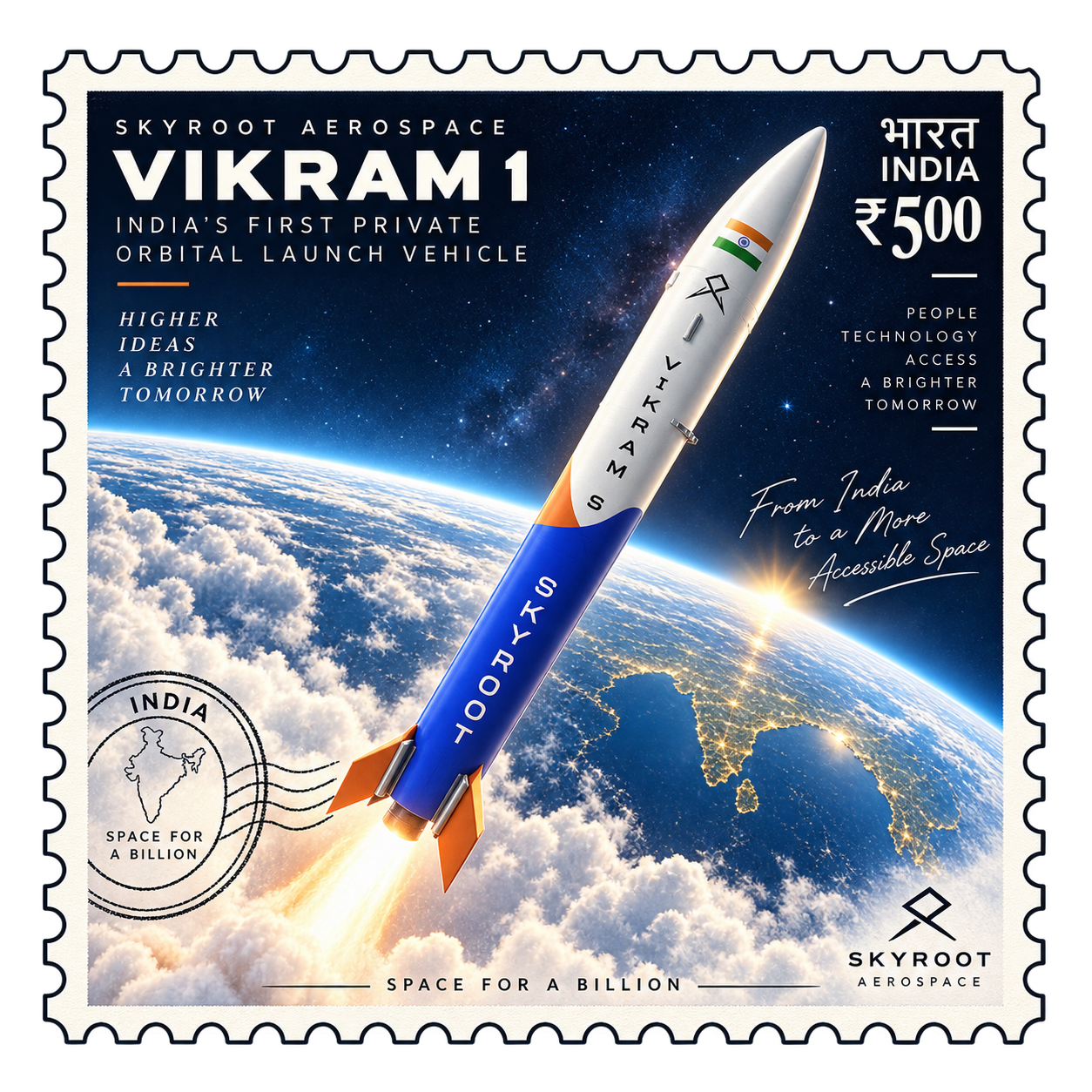
★ FIRST PRIVATE ORBIT ★
Crazy fact
To reach orbit, a rocket can't just go up — it has to fly sideways at nearly 28,000
km/h.
That's about 7.8 km every second. Delhi to Mumbai in under 3 minutes.
Mission cardVIKRAM-1 · AAGAMAN
Mission
Small sats to low orbita dedicated ride, not a rideshare
Payload
up to 350 kgto low Earth orbit
Height
~22 mabout 7 storeys
Stages
43 solid + 1 liquid
Lift-off thrust
~1,000 kNstage 1 alone
Launch site
SriharikotaSatish Dhawan Space Centre
2018
Two ISRO engineers quit and start Skyroot.
2022
Vikram-S: first private Indian rocket, but only a hop.
2026
Vikram-1 makes orbit. India's private space era opens.
YOU'LL DISCOVER →STAGES • ENGINES • THRUST •
3D PRINTING

Predict before you turn →
What do you think is the heaviest part of a rocket?
Write your guess in the margin. Check it on page 2.

SCAN →
BB channel:
watch it come apart
BB channel:
watch it come apart
Data: Skyroot Aerospace / ISRO / public sources · stamp is original artwork, not an official issue
· educational use
P1 / 4